
Hard Metrics Tell You What, Human Factors Tell You Why

What is the best way to measure the health of a team, or an entire organization? Do you only look at so-called hard metrics, like productivity, turnover, and financial results? Or are you also concerned with so-called soft metrics that focus on what people experience, feel and see in and around teams?
The distinction between hard and soft metrics is sometimes raised by customers interested in Columinity. Our platform relies largely on experience-based human factor metrics. In some organizations, there is a belief that only hard metrics are useful, whereas soft metrics are unreliable, subjective and squishy.
In this post, we explain why this is a mistake. Indeed, ignoring human factors and focusing only on hard metrics means closing your eyes to most of what happens in organizations.
A brief history of "hard" and "soft" metrics
The notion of hard metrics harkens back to the theory of Scientific Management introduced by Taylor in the 1880s. It proposes that, to be successful, organizations must measure observable, objective indicators to continuously improve work processes. In the factories at the time, this translated into measuring the output per worker, task completion timing with stopwatches, and cost efficiency. The responsibility for this measurement fell largely on a group of employees, now commonly referred to as middle management or project managers. While Taylor did not invent "middle management", he was the first to formalize their responsibilities as "measurers".

Scientific Management espouses strong mechanistic beliefs about organizations. It assumes that employees are replaceable components of a larger machine. If an employee is not fast enough, they should be replaced. In this metaphor, employees are almost literally seen as cogs in the machine. Any internal lives they may have, and their associated motivations, desires, needs and worries, are considered irrelevant to the functioning of the machine.
But it turned out that these internal lives did impact the machine. Halfway through the 20th century, it became increasingly clear that employees were not replaceable cogs, and that their internal lives - their motivations, desires, and needs - impacted both the organization and each other. These interactions were studied extensively by scientists in the new field of organizational, industrial and social psychology, which blossomed halfway through the 20th century. Scientists like McGregor, Herzberg, Maslow, Mayo, Argyris, Lewin, Schein, Hackman, Tajfel, Bandura and Asch showed how our behavior is influenced in myriad ways by our beliefs and those of the people around us. This research shows how human factors like motivation, leadership, beliefs and attitudes, group identity, social cohesion, shared vision and psychological safety shape behavior in organizations in impactful ways. Ignoring them means closing your eyes to the largest part of what makes an organization: the people working there.
Measuring human factors
To measure productivity at an assembly line, you can simply count the number off items rolling of it every hour. To measure the time it takes to complete a task requires only a (digital) stopwatch. To measure financial performance, you can sum the costs and subtract them from the revenue and arrive at profit.
Human factors seem trickier to measure. How do you measure motivation? Or the level of support people feel from management? Or how cohesive they feel with their team? Since we can't read thoughts, we need other ways. One approach is to observe and measure behaviors that are associated with a mental state. While seemingly more objective, such measures are tricky because different people often express similar states differently in their behaviors. Another approach is to measure physiological responses, like heart rate, brainwaves, sweating and blood pressure. But people also vary in their responses here, and while this may work for strong experiences, it rarely works reliably for nuanced experiences. Wiring up people to sensors is also practically unfeasible in many cases. So the best way is typically to just ask the person directly with a reliable set of questions.
A case in point here is the pursuit of scientists to measure a person's well-being. Initially, scientists like Diener and Kahneman experimented with behavioral and physiological indicators of well-being. But after decades of experimentation, it turned out that the most reliable, accurate way to measure well-being was to directly ask people: "all things considered, how happy are you?".
Of course, measuring human factors with questions such as these isn't without challenges. People may not be (entirely) honest, differ in their level of self-reflection or vary in levels of reading comprehension. So an entire field of psychology emerged to develop robust, reliable and valid ways to measure human factors through survey questions as part of psychometric scales.
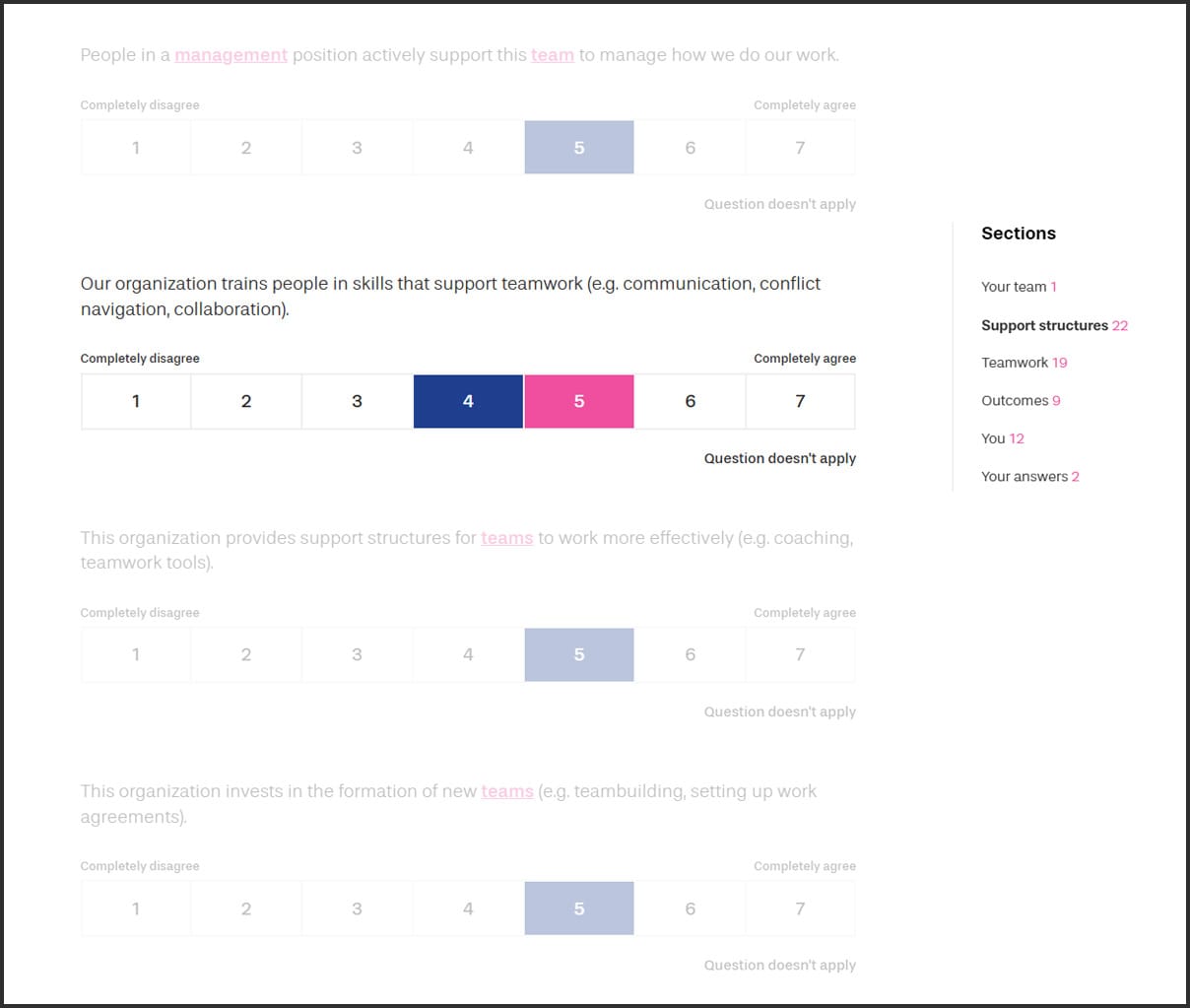
We have established that human factors make up most of an organization and shapes its effectiveness. While their measurement may not be as easy as using a stopwatch to time a task, ignoring them because of this means losing sight of most of what happens in organizations and shapes their effectiveness. So why is the measurement of human factors still frowned upon by some managers?
Measuring outcomes versus process
One reason is that hard metrics like productivity, financial performance and cycle time typically tell you something about the outcomes of a business. How much does it produce? How much money does it make? How many people work there?
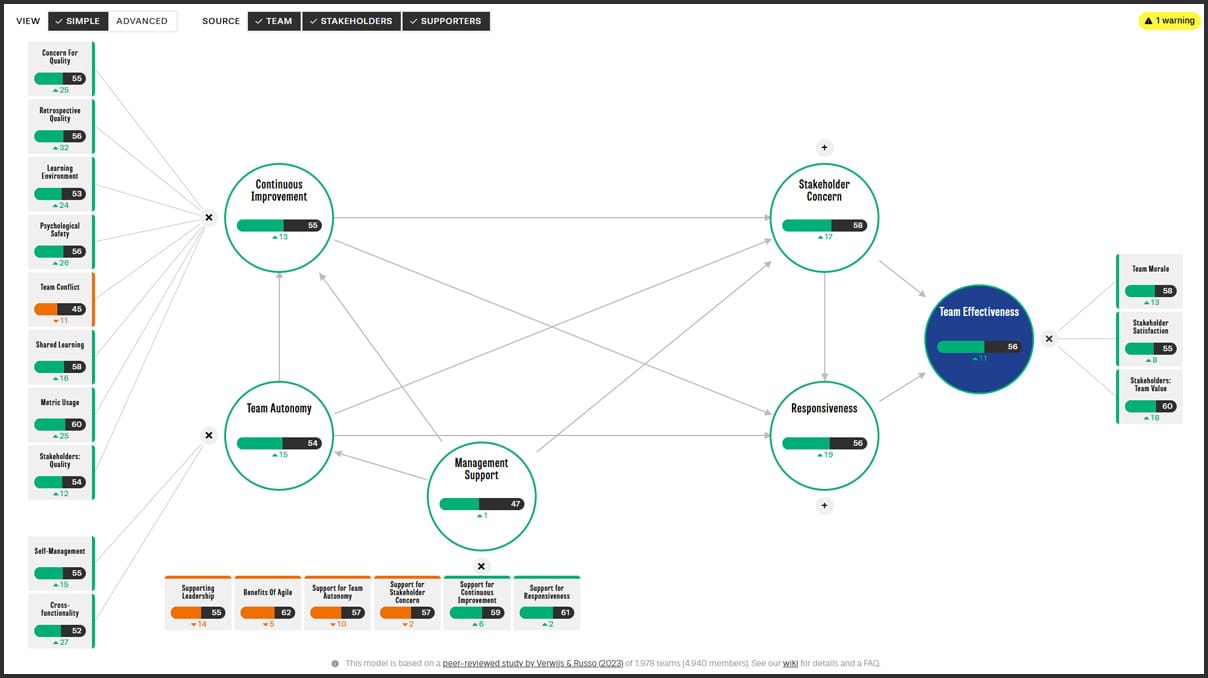
These outcomes are produced by the people who make up an organization. This means that measuring human factors gives you an understanding of the processes that shape those outcomes. It also gives you insights into what might help improve those outcomes. For example, many empirical studies have shown that increasing employee satisfaction, motivation and happiness increases business outcomes. Similarly, our own scientific research shows us that the human factors we measure in Columinity significantly and substantially contribute to team effectiveness, customer satisfaction and team morale.
While hard metrics tell you something about the outcomes of a process, human factors tell you something about that process. This allows managers to identify areas of improvement, and thus contributing to overall business outcomes.
Verifiable, comparable, and tracked over time
Another reason is that hard metrics are assumed to be verifiable, comparable and tracked over time. The assumption is sometimes that human factors are too squishy and abstract, and can therefore be safely ignored.
However, as the above clearly shows that you shouldn't ignore human factors. We've also shown that they can be measured reliably by asking people directly. It requires psychometric scales with good questions that have been validated through research. But when you have those, you can measure human factors in a verifiable, comparable way too, and track their scores over time. This is precisely what we offer with Columinity.
Hard Metrics Tell You What, Human Factors Tell You Why
In short, hard metrics may provide insights into what is happening in your organization, but human factors tell you why it’s happening—and why it matters. Ignoring people's experiences, motivations, and beliefs in organizations is like trying to navigate a ship by looking only at its wake—you miss the currents that truly steer it.
With reliable, research-backed tools like Columinity, you can measure these human factors in a verifiable, comparable, and trackable way, giving you actionable insights into what drives your teams and your organization forward.
Don’t just measure outcomes—understand the processes behind them. Start measuring human factors today and see how people shape the success of their organizations.
Measure human factors in your teams now, with our free scans.
This post was hand-written by Christiaan Verwijs, not by AI.